Chicago Teen “Takeovers”: A Reflection of What’s Missing at Home
Published on Apr 02, 2026
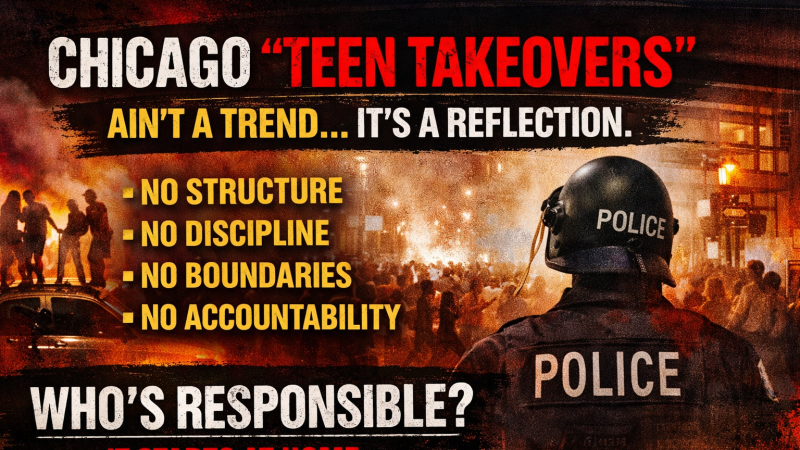
What happened recently in Chicago wasn’t just another viral moment—it was a warning sign.
During spring break 2026, hundreds of teenagers flooded downtown Chicago’s Loop, turning busy streets into chaos. Reports confirmed large-scale fights, teens jumping on cars, use of mace, and at least one teen beaten unconscious. Police were forced to step in with an emergency curfew just to regain control. Eight juveniles were arrested, and dozens of curfew violations were issued.
This wasn’t isolated. It’s part of a growing pattern.
⸻
Not a Trend — A Pattern
Across Chicago and the country, these so-called “teen takeovers” are becoming more frequent and more dangerous. These gatherings—organized through social media—bring hundreds of teens together in public spaces with little to no supervision.
Law enforcement says these events often spiral into:
• Fights and assaults
• Property damage
• Mass panic or stampedes
• In some cases, shootings
Officials have compared them to scenes out of The Purge, where chaos overrides structure and accountability.
Chicago alone has seen multiple takeovers already this year, with some incidents resulting in injuries and even deaths in past cases.
⸻
How Social Media Fuels the Chaos
These events don’t happen randomly.
They are:
• Organized through Instagram, Snapchat, and group chats
• Promoted for clout, attention, and viral moments
• Reinforced by videos that glamorize the chaos afterward
The more attention these incidents get, the faster they spread. One city’s chaos becomes another city’s blueprint.
⸻
The Accountability Gap
Here’s the part many people don’t want to say out loud:
This doesn’t start downtown.
It starts at home.
City leaders continue debating curfews, policing strategies, and youth programs. Some push for stricter enforcement, while others advocate for more resources and outreach.
But even officials acknowledge a deeper issue—parental oversight and early intervention are critical.
Because no program, no policy, and no police presence can replace:
• Structure
• Guidance
• Boundaries
• Accountability
⸻
“Kids Being Kids” — Or Something More?
There’s a narrative that tries to soften what’s happening:
“They’re just kids.”
“It’s just spring break.”
“They’re bored.”
But when teens are:
• Coordinating mass disruptions
• Engaging in violence
• Ignoring authority completely
That’s no longer harmless behavior. That’s learned behavior.
And learned behavior comes from somewhere.
⸻
A Culture Following Chaos
What we’re seeing is a shift:
• Influence over instruction
• Popularity over principles
• Reaction over responsibility
Instead of thinking independently, many are following whatever gains attention—even if it leads to destruction.
And when there’s no consistent correction at home, the streets become the teacher.
⸻
Where the Conversation Needs to Go
Every time something like this happens, the conversation focuses on:
• The police response
• The city’s policies
• The location of the incident
But rarely does it stay focused where it needs to be:
Responsibility.
Because until that conversation shifts:
• The gatherings will continue
• The violence will escalate
• And the same cycle will repeat
⸻
Final Word
Chicago’s teen takeovers aren’t just about teenagers.
They are a reflection of:
• What’s being ignored
• What’s being tolerated
• And what’s missing
At some point, the truth has to be faced:
You can’t fix what’s happening in the streets
without addressing what’s happening at home.