Bo Deal: From the Streets of Chicago to the Vanguard of Hip Hop and Film
Published on Feb 11, 2026
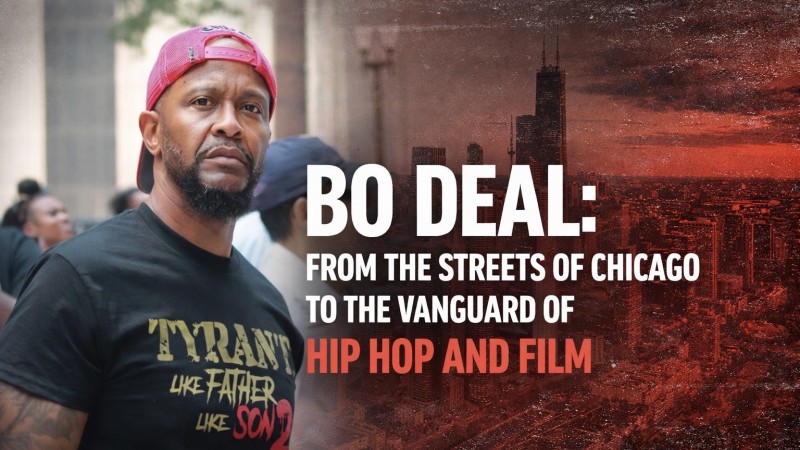
Chicago doesn’t create ordinary stories. It creates survivors.
And few stories carry the weight, contradiction, and evolution of Bo Deal — rapper, actor, activist, and architect of his own reinvention.
“I didn’t start rapping to be famous,” Bo once said. “I started rapping to survive.”
That survival instinct is the throughline of his life.
The West Side Blueprint
Born Billy Deal on March 8, 1978, Bo grew up on Chicago’s West Side — in an environment where codes were learned early and mistakes were costly. Leadership came naturally to him. So did influence. In neighborhoods where young men were often shaped by their surroundings faster than they could understand them, Bo became both student and product of the streets.
A violent assault at 13 left more than physical damage. It planted a vow.
“Before I ever stepped on a stage, I was already fighting for respect,” he’s reflected. “The streets don’t give you grace. They test you.”
That test would eventually lead to a seven-year prison sentence on a drug conspiracy charge — a pivotal chapter that altered his trajectory.
Jail Bars to Rap Bars
Prison has ended many stories. For Bo Deal, it began one.
Inside, music became more than pastime. It became therapy. Identity. Craft. Fellow inmates took notice. So did correctional officers. What started as freestyle sessions turned into disciplined writing. Rhymes became structured. Stories became layered.
“The streets gave me a voice,” Bo has said. “Prison sharpened it. Purpose refined it.”
Upon release, he wasted no time. A low-budget project, Ghetto Passes, circulated. Freestyle tapes reached the right ears. Soon, Bo Deal was dominating BET’s 106 & Park Freestyle Friday, earning national visibility through pure lyrical stamina.
He wasn’t industry-polished. He was raw. And that authenticity resonated.
The Chicago Code
As drill music erupted nationally, Chicago’s sound was under a microscope. Bo Deal stood at an intersection — connected to artists like Waka Flocka Flame and other major figures — but never fully boxed in by trends.
His mixtapes, including Good Side, Bad Side, Chicago Code, and Revelations, captured the duality of his lived experience. He rapped not just about violence, but about consequence. Not just about power, but about paranoia.
“I’ve lived the good side and the bad side,” he’s said. “That’s why my music sounds like both.”
Unlike many peers, Bo prioritized ownership. Through Ground Up Productions, he maintained control of his catalog — a strategic decision reflecting a deeper lesson learned long before music.
“In the streets you fight for respect. In the industry you fight for control.”
For Bo Deal, independence wasn’t rebellion. It was protection.
A New Medium, Same Truth
Music wasn’t the only canvas.
In recent years, Bo expanded into film and television — appearing in projects such as And Just Like That, Young Urban Terrorist, Tyrant: Like Father Like Son, its sequel, and Robbin’ Hoods. On screen, he often inhabits characters shaped by power, conflict, and survival — roles that feel less like performance and more like translation.
“Film is just another way to tell the truth,” he’s said. “The camera sees what the beat feels.”
But acting isn’t simply about playing hardened figures. It’s about complexity. Emotion. Nuance. Where music compresses experience into minutes, film allows it to breathe.
And for Bo Deal, storytelling has always been about realism.
“You can’t preach change if you’ve never faced consequence.”
From Influence to Intervention
If his early years were about reputation, his current chapter is about responsibility.
Through Perfect Vision Empowered (PVE), Bo has invested himself in violence prevention and community outreach across Chicago. He speaks with young men who mirror his past. He intervenes in conflicts before they escalate. He uses credibility not to intimidate, but to mediate.
“Chicago isn’t just violence,” he insists. “It’s brilliance under pressure.”
Recognition followed. Awards. Acknowledgment from respected leaders. But for Bo, the real metric is impact.
“If I can stop one young brother from making the mistake I made, that’s bigger than any chart position.”
The work is personal. And urgent.
Legacy in Motion
Bo Deal’s evolution defies neat categorization. Rapper. Actor. Activist. Mentor. Survivor.
He is proof that identity is not static — that transformation is possible even for those written off by statistics.
“I’m not trying to escape my past,” he’s said. “I’m trying to build something bigger than it.”
Chicago has always been a city of tension — art and anguish, genius and grief. Bo Deal embodies that tension. But more importantly, he represents progression.
Survival was the first chapter.
Purpose is the one he’s writing now.