Do or Die: The Melodic Hustlers Who Gave Chicago Its Platinum Pulse
Published on Feb 24, 2026
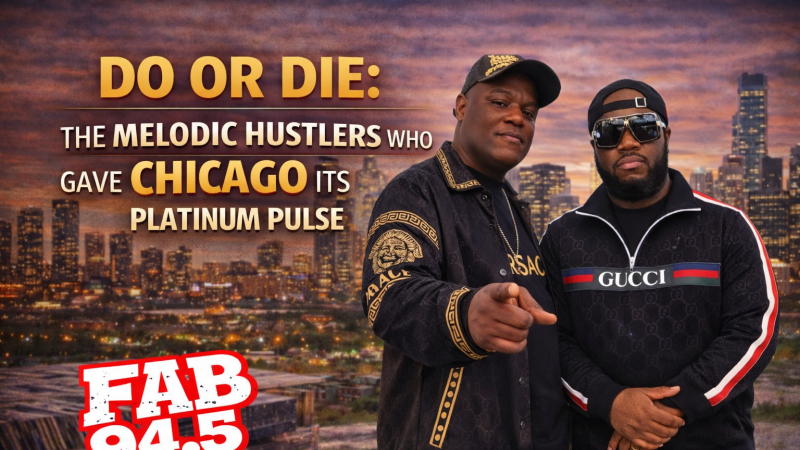
Chicago has always been a city of resilience. Of steel. Of survival. Long before drill music rattled the global speakers and before streaming redefined regional dominance, three young men from West Garfield Park carved out a sound that was fluid yet fearless, melodic yet militant. They called themselves Do or Die — and in the mid-’90s, they shifted the gravitational pull of hip-hop toward the Midwest.
They weren’t loud about it. They didn’t need to be.
Their music did the talking.
The West Side Blueprint
Formed in Chicago’s K-Town neighborhood, the trio — AK-47, Belo Zero, and N.A.R.D. — began as dancers before transitioning into rap, absorbing the pulse of the streets long before they pressed it into wax. Their early sound was shaped alongside producer The Legendary Traxster, whose icy, minimalist production became the sonic backbone of their identity.
They were fast — triple-time flows cascading over syrup-slow beats. It was a contradiction that worked. Their cadence glided while their words hit hard.
In 1996, that chemistry crystallized into one record that would alter Chicago’s position in the rap hierarchy forever.
“Po Pimp” and the National Arrival
When “Po Pimp” hit the streets, it didn’t sound like New York. It didn’t sound like Los Angeles. It sounded like Chicago — melodic, street-aware, and unapologetically smooth. The single climbed to No. 22 on the Billboard Hot 100, and their debut album Picture This went platinum. Suddenly, the Midwest wasn’t an afterthought; it was a movement.
Signed to Houston’s Rap-A-Lot Records, Do or Die bridged regions before that was fashionable. They collaborated across cities and styles, helping normalize the idea that Chicago artists could thrive on a national stage without diluting their accent or aesthetic.
Their follow-up albums — Headz or Tailz, Victory, Back 2 the Game, and others — reinforced their consistency. Even when radio trends shifted, their formula of harmony-laced street narratives remained intact.
Brotherhood, Setbacks, and Survival
Like many groups forged in real environments, their story included turbulence. Legal troubles, industry shifts, and the unforgiving pace of music business cycles tested the trio. Yet they endured — touring, recording, and sustaining a catalog that quietly influenced generations that followed.
And then came a loss that would permanently change the group’s chemistry.
On May 1, 2021, AK-47 — born Anthony Round — passed away in Chicago at the age of 47. For fans, it was more than the loss of a rapper. It was the loss of a voice that had defined a specific moment in Chicago’s sonic evolution.
AK-47’s delivery had always been distinctive: rapid but controlled, gritty yet melodic. His presence in Do or Die was foundational. Without him, the trio’s original configuration became history.
His passing marked the end of an era — but not the end of the legacy.
Legacy Beyond Nostalgia
Today, Belo Zero and N.A.R.D. continue to carry the torch, performing classics that still ignite crowds nearly three decades after their debut. “Po Pimp” remains a staple in Chicago nightlife and hip-hop retrospectives alike — not as a relic, but as a reminder.
Long before streaming analytics and viral algorithms, Do or Die built something organic. They proved that Midwest storytelling could be commercially viable without sacrificing authenticity. They influenced artists who came after — from the rapid-flow technicians to those who blur melody and grit.
Their contribution isn’t always shouted in mainstream retrospectives. But it’s embedded in the DNA of Chicago rap.
Why Do or Die Still Matters
Every city has architects — the ones who build foundations others later decorate. Do or Die were architects.
They helped position Chicago as more than a regional scene. They helped create a lane where vulnerability and bravado could coexist in the same verse. And through triumphs, trials, and tragedy, they embodied the philosophy embedded in their name.
Do.
Or.
Die.
And in doing so, they ensured that their sound — and AK-47’s voice — will echo far beyond the West Side streets that birthed it.