“The Funny Man From Chicago”: Inside the Enduring Legacy of Damon Williams How a Sandwich Shop Owner Became a Stand-Up Institution
Published on Feb 20, 2026
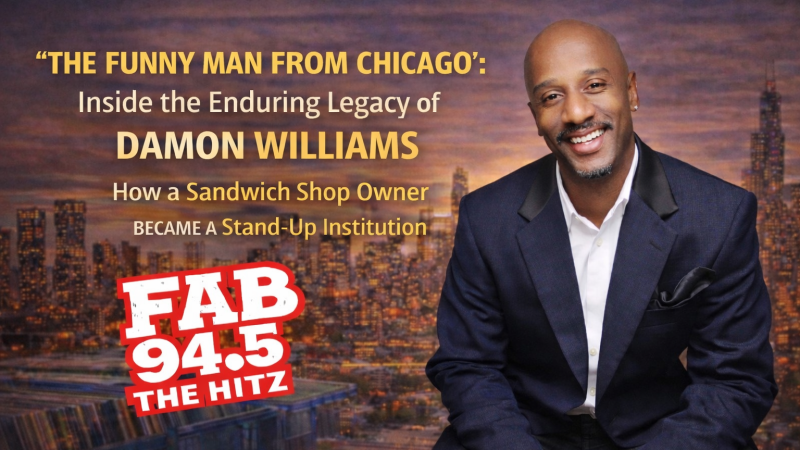
When Damon Williams walks into a comedy club — any club, in any city — there’s a history that precedes the familiar laughter. It isn’t just the punchlines audiences have memorized over decades. It’s the presence of someone who has been there, who has shaped stages and opened doors not just for himself, but for the broader culture of stand-up. In every sense, Williams is one of comedy’s quietly monumental figures.
Before the Spotlight: Beginnings in Chicago
Long before he had headlines or a touring schedule, Williams was known simply as the guy with the quick wit at the counter of his own Subway sandwich shop. In early-1990s Chicago, he flipped subs by day and soaked up punchlines by night, performing at the city’s legendary open mic rooms — most notably the famed All Jokes Aside Comedy Club. It was the kind of stage where comics tested material that cut close to life: family, struggle, race, identity, survival. And Damon took to it naturally.
That era — raw and formative — wasn’t a footnote. It was a crucible: an environment that would forge a style rooted in straightforward observation, human vulnerability, and Chicago’s distinctive edge.
Breaking Through in the ’90s
By the mid-1990s, Williams had become a visible presence on national television. His stand-up was featured on BET’s “Comic View”, where he built genuine momentum and even earned his own one-hour special — a rare achievement that signaled both market reach and respect in a crowded field of emerging comedians.
But it was 1999 that marked a seismic shift. Williams landed the opening spot on the legendary Kings of Comedy Tour, performing to hundreds of thousands of people nationwide. That tour itself was a cultural event — a showcase of Black comedic excellence that redefined stand-up for a generation — and his inclusion on that roster cemented his place among the elite.
A Multidimensional Entertainer
Since those early milestones, Williams has worn almost every creative hat in entertainment:
• Television & Film: From appearances on Comedy Central’s “Premium Blend” and HBO’s Bad Boys of Comedy to roles in films like Heaven on Seven and sitcom spots on Bounce TV, Williams translated his stage charisma into screen presence.
• Radio & Hosting: For eight years, he sat in The Funny Chair on the nationally syndicated Tom Joyner Morning Show, where his humor and commentary reached millions.
• Streaming & Production: In the streaming era, Williams evolved again. He executive produced and hosted his own series, Laugh Tonight with Damon Williams, streaming across platforms like UrbanflixTV and Tubi.
• Curator & Mentor: In his hometown region, he keeps the grassroots alive by curating showcases at Riddles Comedy Club, helping newer voices find footing on stages once reserved for legends alone.
Comedy That Endures Because It’s Real
Part of Williams’s staying power comes from his perspective: he isn’t a comedian chasing virality. He’s a storyteller — one deeply grounded in life’s ironies, the lessons of parenthood, community rhythms, and the daily grind. He once said that inspiration comes from listening to life around you, especially in a city like Chicago, where the sounds of struggle and resilience are inseparable.
And that authenticity translates — not just in jokes, but in the relationships he’s built across generations of fans and comics alike. From audiences who remember his first TV appearances to newer crowds discovering him on social platforms or at festivals, there’s a throughline: Williams’s comedy feels like a conversation, not a performance.
Legacy in Motion
At more than 30 years into his career, Damon Williams’s trajectory still looks less like a fading legend and more like that of a craftsman in full stride. He’s not a relic of ’90s stand-up — he’s a bridge between eras. He’s someone who’s seen the business change and, crucially, evolved with it without losing himself.
In a cultural landscape where comedy often prizes shock value, viral bites, or fleeting memes, Williams’s legacy feels refreshingly substantive. He stands as a testament to consistency, adaptability, and deep respect for the art form itself.
Because at the end of the night, when the lights are low and the crowd is quieting down, what matters most isn’t the biggest laugh of the decade — it’s the one that stays with you. And there are thousands of those in Damon Williams’s career.