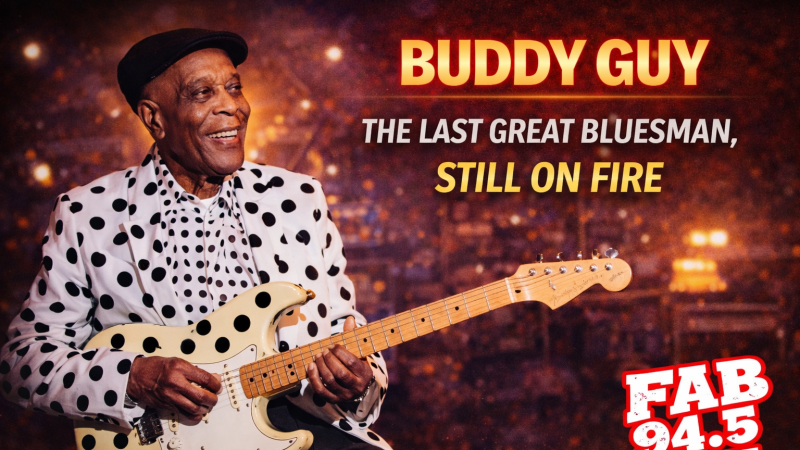
Buddy Guy: The Last Great Bluesman, Still All Fire
Published on Feb 17, 2026
July 30, 1936 — Lettsworth, Louisiana.
A sharecropper’s son is born into a world defined by hard work, cotton fields, and the sultry hum of Southern radio. He fashions his first instrument, endlessly bending wires and wood scraped from a neighbor’s screen. From that improvised guitar, a journey begins — one that would come to reshape the sound of the electric guitar, bridge generations of musicians, and keep the spirit of the blues alive for nearly seven decades.
His name: Buddy Guy — and at 89, he’s still reminding the world why the blues matters.
From Sharecroppers’ Fields to Chicago Clubs
Born George Guy in a tiny Louisiana hamlet, Buddy’s early childhood was devoid of glamour. But he carried something priceless: a visceral connection to sound. A ragged homemade guitar taught him the rudiments, and listening to blues giants on the radio taught him the soul. By his teens, he was playing clubs around Baton Rouge, earning every note with sweat and grit.
In 1957, with nothing but a suitcase and a burning ambition, he moved to Chicago — then the epicenter of postwar electric blues. Within months, he was in the orbit of legends: Muddy Waters took him under his wing, introducing him to the backstage world of the iconic 708 Club and the Chicago circuit. It was here that Buddy’s style — equal parts raw emotion and unhinged innovation — began to form.
Crafting a Sonic Revolution
Buddy Guy did more than play the blues — he bent it, stretched it, and electrified it. While many guitarists used distortion and feedback accidentally, Buddy embraced it with intention. A now-famous anecdote recounts how a passerby’s dress tail brushed his plugged-in guitar, producing sustained feedback that he realized could be a musical tool — long before many rock players adopted the same sound.
His live performances earned a reputation for danger and ecstasy. He played with drumsticks, behind his head, with his teeth — demonstrating that blues performance could be theatrical without losing its emotional core. These feats weren’t just showmanship; they signaled a new era of guitar expression, influencing countless musicians.
Sideman, Partner, and Early Recordings
In the 1960s, Buddy recorded for Chess Records, contributing powerful sessions with giants like Howlin’ Wolf, Little Walter, and Koko Taylor. Yet mainstream success was slow, in part because labels didn’t quite know how to capture his unfiltered electric aggression. His collaboration with harmonica star Junior Wells yielded some of the era’s most celebrated blues recordings and cemented a partnership that would last decades.
The Long Road Back: Blues Revival and Global Recognition
Though the popularity of blues waned in the ’70s and ’80s, Buddy never stopped performing. His authenticity kept him in the hearts of artists like Eric Clapton and Jeff Beck — British musicians who themselves helped revive interest in foundational American blues. In 1990, Clapton invited Buddy to play at the Royal Albert Hall in London, igniting a late-career resurgence.
The 1991 album Damn Right, I’ve Got the Blues marked his commercial breakthrough, winning a Grammy and introducing a new generation to his fierce, soulful music.
Over the next decades, Guy became impossible to ignore: multiple Grammy Awards, a National Medal of Arts, Kennedy Center Honors, and induction into the Rock & Roll Hall of Fame. He also opened his own club — Buddy Guy’s Legends in Chicago — a home for the music he cherished and a living monument to blues culture.
Legacy, Influence, and Cultural Resonance
Few artists have left fingerprints across so many musical landscapes. From Jimi Hendrix to Stevie Ray Vaughan, from Keith Richards to John Mayer, modern guitarists cite Buddy Guy as a foundational influence. Yet he never lost sight of his roots: the blues, he said, is music about life, with all its heartbreak and glory.
In 2025, Buddy released Ain’t Done with the Blues on his 89th birthday — a declaration rather than a statement of age — collaborating with guitar greats like Joe Walsh and Peter Frampton. That same year, his cameo in the critically acclaimed film Sinners introduced his presence — and the blues itself — to a new audience, bridging generational divides in an era dominated by digital noise.
The Man Today
As he nears 90, Buddy Guy’s life reads like a living blues epic: a journey from the cotton fields of Louisiana to the stages of the world; from sideman to icon; from unsung innovator to bearer of America’s oldest popular musical tradition.
Even as he announces new tour dates in 2026 — the “Buddy Guy 90 Tour” — his mission remains clear: to keep the blues alive — not as nostalgia, but as a living, breathing form that still speaks to the human experience.
He once said that the blues would die with him. But perhaps that’s never been true. Because the music he taught the world — through every note of feedback, every howl of guitar, and every sweat-soaked performance — lives in the hands of players who came after, and in the hearts of listeners who feel it. And long after personal fame fades, Buddy Guy’s blues will still echo.