Jesse Jackson: The Conscience That Refused to Be Quiet
Published on Feb 17, 2026
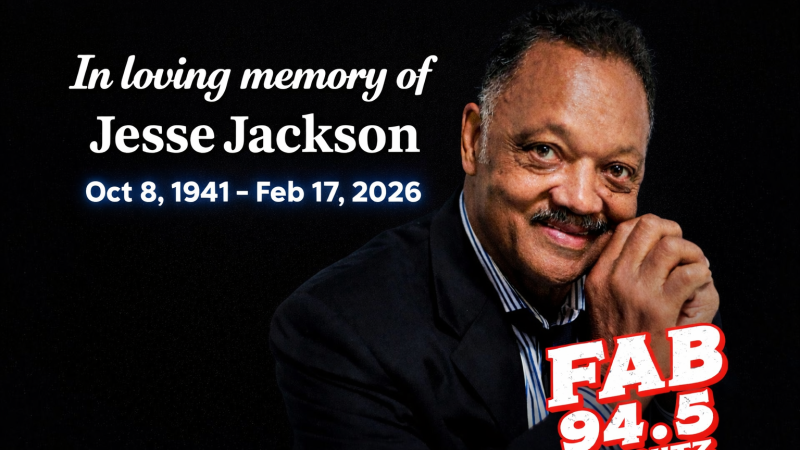
There are men who chase history. And then there are men who bend it.
Jesse Jackson was the latter.
For more than half a century, Jackson stood at the fault lines of America — race and power, poverty and possibility, faith and politics — refusing to flinch. He was not a background figure in the civil rights movement. He was not a footnote to someone else’s revolution. He was, in every sense, a continuation of it.
With his passing, America loses not just a leader, but a voice that never learned how to whisper.
From Greenville to the Global Stage
Born in 1941 in Greenville, South Carolina, Jackson came of age in the segregated South — a place that tried to define Black ambition as dangerous. But ambition was precisely what he carried.
He attended North Carolina A&T State University, where he found both faith and fire. It was there that he began organizing, preaching, mobilizing. The pulpit and the protest line would become twin stages for his life’s work.
His national emergence came under the mentorship of Martin Luther King Jr.. As a young activist within the Southern Christian Leadership Conference (SCLC), Jackson demonstrated an electrifying ability to speak to crowds not just with rhetoric, but with rhythm. He understood cadence. He understood television. He understood power.
After King’s assassination in 1968, many wondered who would carry the torch. Jackson did not claim to replace King — but he refused to let the flame die.
Operation PUSH and the Business of Justice
In 1971, Jackson founded Operation PUSH (People United to Save Humanity). It was more than a civil rights organization. It was an economic intervention.
Jackson believed the next frontier of the movement was not just voting booths — it was boardrooms.
He pressured corporations to hire Black executives, invest in Black communities, and open contracts to minority-owned businesses. Before diversity became a corporate buzzword, Jackson was demanding it as a moral obligation.
Later, he founded the Rainbow Coalition — a political movement that reframed the electorate not as fragmented identity groups, but as a coalition of the overlooked: Black Americans, Latinos, working-class whites, farmers, women, and labor unions.
It was a radical redefinition of power.
The Presidential Campaigns That Changed the Map
When Jackson ran for president in 1984 and again in 1988, it was not symbolic. It was seismic.
His 1988 campaign, under the Rainbow Coalition banner, won 13 primaries and caucuses. He placed second in the Democratic primary race. No Black candidate had ever come that close to the Oval Office.
Long before Barack Obama became president, Jackson proved that a Black candidate could build a national coalition and win states across regions.
He expanded the Democratic Party’s imagination. He registered millions of new voters. He forced national debates around apartheid in South Africa, Palestinian rights, economic inequality, and voting access.
He did not merely run for president — he redefined who could.
A Diplomat in a Clergyman’s Suit
Jackson’s activism extended beyond American borders.
He negotiated the release of American hostages in Syria and Cuba. He met with world leaders in situations where formal diplomacy had stalled. He operated in a space between preacher and envoy — moral authority paired with political audacity.
Critics sometimes questioned his methods. But even critics acknowledged his reach.
He understood something essential: moral pressure moves where policy hesitates.
Controversy, Complexity, and Conviction
No man who lives publicly for five decades escapes scrutiny. Jackson was no exception.
He faced criticism for controversial remarks, political rivalries, and personal missteps. Yet through it all, he remained — visible, vocal, unretired.
Parkinson’s disease, diagnosed publicly in 2017, slowed his body but not his conviction.
He continued to show up. At rallies. At funerals. At moments of crisis.
Because to Jesse Jackson, absence was surrender.
The Voice That Carried a Movement
There was a certain music to Jackson’s speeches.
“I am somebody.”
“Keep hope alive.”
He understood affirmation as resistance. In a country that routinely told Black Americans they were less, he declared them more — loudly.
His presence bridged eras: from segregation to Obama, from Selma to social media.
He was criticized. He was caricatured. He was celebrated. But he was never irrelevant.
Legacy: The Architecture of Access
What remains?
Millions of voters registered.
Corporate diversity pipelines forced open.
A generation of Black politicians who ran because he ran first.
He helped normalize the idea that the margins could become the majority. That coalition-building was not weakness, but strategy. That moral language belonged in political arenas.
He made it impossible to pretend that power did not need to answer to justice.
Jesse Jackson did not live a quiet life. He lived a consequential one.
And in the end, that may be the highest form of legacy: not perfection, but persistence. Not purity, but participation. Not silence, but sound.
America is different because he refused to sit down.
And even in death, the echo remains.