Hearon Trackz: The Quiet Architect Behind Chicago’s Sound
Published on Feb 18, 2026
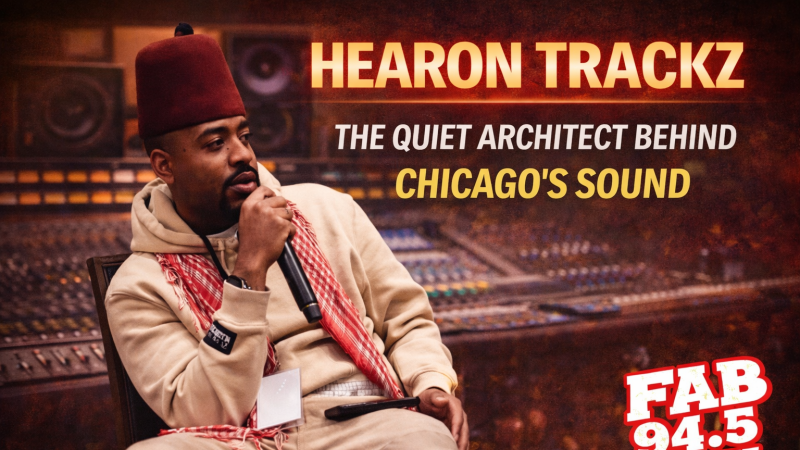
How a producer from the Windy City helped shape drill, lift local voices, and forge a legacy outside the spotlight.
Chicago — long defined by its contradictory pull between innovation and struggle — has given the world a hip-hop sound that’s as unfiltered as its streets: drill music. If drill is Chicago-made thunder, then Hearon Trackz — also credited as HearonTrackz EL — is one of its engineers. He’s a composer, producer, and sonic cultural worker whose fingerprints are etched into the foundations of modern Chicago hip-hop, even if his name hasn’t always been in bold.
The Early Beat Maker
Long before drill music became a global phenomenon with billions of streams and a slew of imitators from London to Australia, Trackz was already operating in Chicago’s creative networks. A Moorish American music composer from Illinois, he emerged as a producer and tastemaker with more than two decades of experience, developing rhythms and loops that would help define Chicago’s darker, uncompromising sonic palette.
According to music industry sources, Trackz turned down a major label deal in 2001, choosing instead to invest in his community — passing the opportunity to a friend and collaborator, Chicago artist MarVo — and entering the U.S. Army, where he continued making beats even between missions overseas.
This period of dual service — soldier and artist — would become a defining undercurrent of his identity: disciplined, rooted in brotherhood, and unafraid to build while others slept.
Crafting the Sound of a City
In an ecosystem where beats were once borrowed and recycled from the coasts, Trackz’s work helped give drill its distinct pulse — stark bass, skeletal drums, and raw edges that felt like coming of age in the city’s unforgiving winters. Through collaborations and studio seasons, he helped launch or elevate the careers of artists such as King Louie, Shawnna, Queen Key, MarVo, Ty Money, Twista, and Do or Die — names that, for many fans, are synonymous with Chicago authenticity.
Those aren’t just credits. They are cultural touch points — landmarks in Chicago’s hip-hop timeline where drill wasn’t a fleeting sound but something with roots and resonance.
“Chicago artists were telling their truth, and the beats had to match that honesty — sometimes harsh, sometimes hopeful, always real,” a longtime collaborator told us. Trackz understood that tension before most.
The Body of Work
Trackz’s catalog is deep, expansive, and often overlooked by mainstream critics. From beat tapes that span years to full projects with street favorites, his output charts the evolution of underground production:
• Super Producer Beat Realz, Vol. 1 (2018) — an early binder of his core sound.
• God 0f Audio: Beat Tapez, Vol. 4 (2018) — twelve tracks showing range and depth.
• Classicz: Since 2005 (Beat Tapez Vol. 6) (2020) — a reflective archive documenting his path.
• quaDRILLogy pt. 1: The Graduate (2025) — one of his latest projects, expanding both sonic and narrative ambition.
It’s not just quantity — it’s cultural DNA. A drum pattern or melodic cadence that starts in his studio often ends up becoming an entire lane for an artist to write their life into.
A Legacy Beyond Credits
What sets Trackz apart isn’t merely the artists he’s worked with or the beats he’s crafted; it’s his commitment to Chicago. Unlike many producers who relocate for fame or easier industry access, Trackz stayed — cultivating talent, building frameworks, and anchoring his sound in place. According to industry tracking, he declined multiple offers to take his talents elsewhere, choosing instead to remain in the city that shaped him.
His presence has been formative to drill’s evolution — not as a front-page name but as the catalytic force in countless sessions, late nights, personal investments, and community connections. Even platforms like SoundCloud showcase recent work that speaks to an artist still hungry to push and refine.
Why Trackz Matters Now
Drill music, once dismissed as transient noise, is now a global grammar. But its true dialect — the nuance and specific cadence that comes from lived experience — was shaped by architects like Hearon Trackz long before playlists and pundits arrived.
In a moment where culture increasingly looks for flash and celebrity, Trackz offers something harder: durability.
With a life spent wrestling both beats and the realities of his city, his story isn’t about instant discovery or overnight fame — it’s about persistent influence.
And as Chicago’s next generation rises, confident in telling its own story, it’s producers like Trackz — unassumingly at the controls — who built the room they stand in.