Lateefa “Teefa” Harland: The Woman Who Helped Chicago Find Its Female Rap Voice
Published on Feb 26, 2026
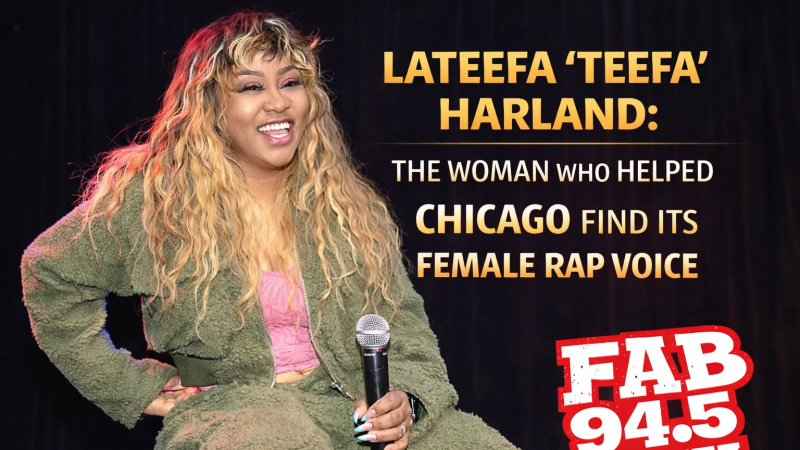
Before the blogs. Before drill went global. Before the city’s women MCs claimed viral dominance — there was Teefa.
On a humid summer night on Chicago’s South Side, long before streaming metrics and social media validation, Lateefa Harland stood in a circle of folding chairs and milk crates, notebook in hand, studying rhythm like it was a science. The bass from a passing Cutlass rattled windows. The city felt loud, competitive, unrelenting.
And she was calm.
That calm would become her signature.
Before she was known on Instagram as @teefa_fatima, before nostalgia posts and anniversary tributes, she was one half of something revolutionary: Infamous Syndicate — one of the first nationally recognized female rap duos out of Chicago.
The late 1990s were not particularly kind to women in hip-hop. They had to be louder. Harder. Sharper. Or risk invisibility. Chicago, at the time, wasn’t yet the rap capital it would later become. It was known for house music, for the blues, for poets with open-mic grit — but not for charting female MCs.
Teefa helped change that.
The Birthday Party That Started It All
Legend has it the partnership began at her 17th birthday party. That’s where she met Rashawnna Guy — the future Shawnna — and something clicked. Two young women with completely different cadences but identical hunger.
Soon, they became Infamous Syndicate.
Their chemistry wasn’t accidental — it was structural. Shawnna delivered rapid-fire intensity. Teefa brought composure. If Shawnna was lightning, Teefa was voltage — steady, controlled, powerful without spectacle.
Their local buzz turned into something bigger: a deal with Relativity Records, a serious accomplishment for two young Black women from Chicago at a time when major labels weren’t lining up to sign female rap acts — let alone from the Midwest.
In 1999, they released Changing the Game.
The title wasn’t marketing fluff.
It was intention.
The album climbed onto the Billboard R&B/Hip-Hop charts. The single Here I Go gained traction. Chicago radio rotated it. Industry ears perked up. Producers like No I.D. and a then-emerging Kanye West were shaping the sonic texture behind the scenes.
The industry noticed.
But Chicago understood.
The Balance of Power
In archived coverage from Vibe, Teefa was described as the more measured presence — strategic, thoughtful. Not the loudest voice in the room, but often the most deliberate.
And that distinction matters.
Hip-hop history often celebrates extremes — the most controversial, the most explosive, the most viral. Teefa’s power was different. She delivered bars with surgical pacing. She didn’t chase aggression; she mastered control.
In a city that demands toughness, she embodied composure.
That composure gave Chicago’s women rappers a different blueprint: You didn’t have to perform hyper-intensity to command respect. You could be poised and still be powerful.
When the Industry Shifted
By 2000, the duo dissolved amid label turbulence and shifting industry politics. The late ’90s rap landscape was volatile. Deals collapsed quickly. Priorities shifted even faster.
Shawnna would later gain national fame under Ludacris’ Disturbing Tha Peace imprint.
Teefa’s path was less public — but not less significant.
Instead of chasing major-label optics, she stayed rooted in Chicago’s ecosystem. Community stages. Radio spaces. Studio sessions. Mentorship. The real infrastructure of culture.
Not every architect gets headline credit.
But without architects, there are no skylines.
The Instagram Era: @teefa_fatima
Scroll through @teefa_fatima today and you won’t find desperation for algorithm validation. What you see instead is presence. Experience. A woman who understands that legacy isn’t measured in followers — it’s measured in foundation.
The posts feel intentional. Reflective. Grounded in artistry rather than nostalgia.
There’s something powerful about artists who lived through physical mixtape eras adapting to digital timelines without losing their core.
Teefa doesn’t present herself as a relic of the ’90s.
She presents herself as continuity.
Chicago’s Female Rap Renaissance — and Her Invisible Influence
Fast-forward to today. Chicago has become one of hip-hop’s most globally discussed cities. Drill reshaped the sound of rap worldwide. Women artists from the city are charting, touring, building brands.
That visibility didn’t appear out of thin air.
Before it was commercially safe for Chicago women to rap nationally, Infamous Syndicate proved it was possible.
Before social media made branding accessible, Teefa and her peers built audiences hand-to-hand.
Before the industry valued “Midwest voices,” they forced executives to listen.
You can’t talk about Chicago women in hip-hop history without acknowledging the bridge generation.
Teefa is part of that bridge.
A Legacy Beyond Loudness
Some artists peak and disappear. Others evolve quietly, shaping rooms rather than headlines.
Teefa belongs to the second category.
Her story challenges the idea that impact must be flashy to be meaningful. Sometimes the most important figures are the ones who created space where none existed before.
There’s a certain elegance in that.
In an industry obsessed with reinvention, Teefa’s legacy is rooted in origin. She was there when Chicago’s female rap voice stepped into national light — and she helped hold the mic steady.
That steadiness may be her greatest contribution.