The Unseen Architects of Chi-Town: How Speedknot Mobstaz Went From Street Cyphers to Hip-Hop Obscura
Published on Feb 26, 2026
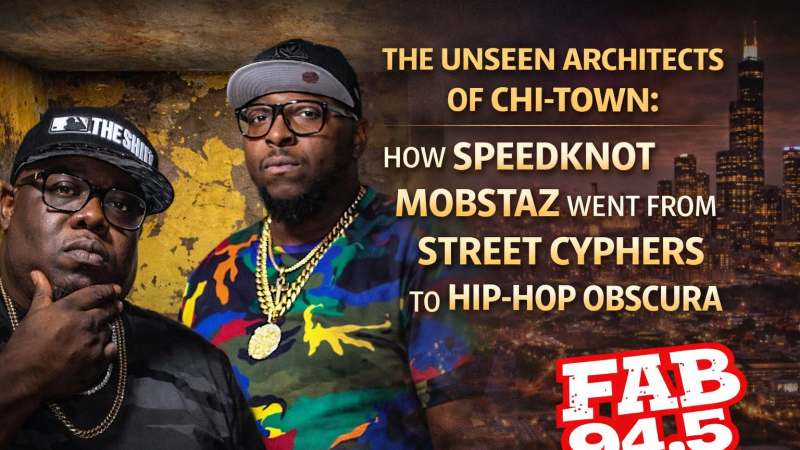
When you talk about Chicago’s hip-hop legacy — from boom bap to drill — there’s always a handful of names that rise to the surface: Twista, Common, Kanye West, Chance… even Do or Die. But there’s a pair of voices that never got the glossy retrospective treatment they deserve: Liffy Stokes and Mayz, the avatars of grit and cadence who together became Speedknot Mobstaz.
Their story isn’t one of overnight fame or glossy crossover; it’s a testament to survival — artistic, personal, and cultural — out of the woodwork of Chicago’s West Side, where aspirations often outgrow opportunities.
Roots in the Chi
Chicago in the late ’80s and early ’90s was an incubator of styles — gritty poetry over crate-dug beats, preaching real life without the veneer of pop ambition. It was here that young Liffy and Mayz found each other, neighbors drawn together by a mutual hunger for rhyme, rhythm, and escape. According to local lore, they clicked immediately — sharing blocks, beats, stories, and the kind of lyrical restlessness that would define their sound.
Their shared hunger intersected with destiny when one night, while cruising the West Side, they encountered a young Twista — already turning heads with a delivery so rapid the Guinness Book of World Records once declared him the fastest English-speaking rapper alive.
Whether it was a cypher at a gas station or an impromptu battle on a street corner, something clicked — not just stylistically, but spiritually. Twista invited them into his studio, and suddenly these local emcees were learning how to structure bars, ride beat changes, and translate street talk into recorded truth.
Mobstability: A Testament to Chicago
By 1998, Speedknot Mobstaz had an album ready — Mobstability. While often categorized as a collaborative record with Twista, it was really a statement of intent. The tracks didn’t just rap about violence or wealth; they painted portraits of Cook County — “Crook County” as they’d cheekily call it — where every corner held a lesson, and every beat echoed with lived experience.
Mobstability sold more than 700,000 copies and went Gold, but it never became a cultural mainstream moment the way other Chicago landmarks did. Tracks like “In Your World” — later featured on the Dr. Dolittle soundtrack — offered glimpses of something deeper: vulnerability wrapped in rugged delivery.
Yet underneath the modest sales numbers was something more durable: authenticity. The album sounded like Chicago — dense with tension but still melodic, unfiltered but articulate. It became one of those records where every listener feels as if the artists are speaking directly to their hopes and hardships, even if the rest of the world never fully tuned in.
The Long Road and Second Coming
The years after Mobstability were not kind in the commercial sense. Label wrangling delayed projects and dampened momentum. But Liffy and Mayz kept pushing. They stayed active — touring with Twista, appearing on compilations, staying rooted in the city that shaped them.
A decade later, in 2008, they re-emerged with Mobstability II: Nation Bizness, released under Twista’s Get Money Gang label. It was a record that acknowledged their roots while staking a claim on relevance in a very different musical landscape. Featuring guest appearances from notable artists like Jim Jones and production rooted in Chicago’s underground, the album didn’t rewrite the duo into platinum status — but it reinforced their legacy as storytellers, not trend followers.
More Than Footnotes
Speedknot Mobstaz never became household names. They didn’t headline Coachella stages or light up TikTok. But to understand Chicago’s hip-hop DNA, you need to trace the lines back to them. Their cadence, rugged lyricism, and refusal to hide from hard truths helped shape a regional sound that — through artists like Twista and beyond — would influence an entire generation of Midwest lyricists.
In a world where fame and visibility are often mistaken for impact, Speedknot Mobstaz remind us that legacy can also live in the margins — in stories passed from crate-digging heads to fledgling emcees in basement cyphers, and in tracks that, decades later, still carry the pulse of the streets that birthed them.
They didn’t just rap fast — they spoke with the velocity of experience. And in that sense, their story remains unfinished — waiting for rediscovery by those who look past charts and playlists for truths embedded in rhythm and rhyme.
Where Are They Now?
Unlike many regional legends who fade into nostalgia circuits, Speedknot Mobstaz remain creatively active.
Liffy Stokes has continued releasing independent music, collaborating with emerging artists, and maintaining a visible presence in Chicago’s hip-hop ecosystem. His solo efforts reflect maturity — still sharp, but reflective. The hunger never left; it just evolved.
Mayz, more reserved publicly, has maintained ties within the culture and remains aligned with the Mobstaz legacy. While not constantly in front of cameras or headlines, the foundation he helped build remains intact.
They haven’t officially disbanded. They haven’t announced farewell tours. They exist in that rare space where artists transition from current act to cultural cornerstone — still moving, just without the noise machine.
Because Speedknot Mobstaz were never about spectacle.
They were about stamina.
Legacy Beyond Algorithms
Today’s Chicago rap scene — from lyrical purists to drill architects — stands on layers of influence. And somewhere in that lineage are two West Side emcees who helped define what rapid-fire Midwest storytelling could sound like before it was monetized by streaming metrics.
Speedknot Mobstaz didn’t just rap fast.
They narrated a city in real time.
They built bridges between street narrative and technical mastery.
They proved that longevity isn’t always loud.
Sometimes, it’s steady.
And in Chicago, steady still matters.