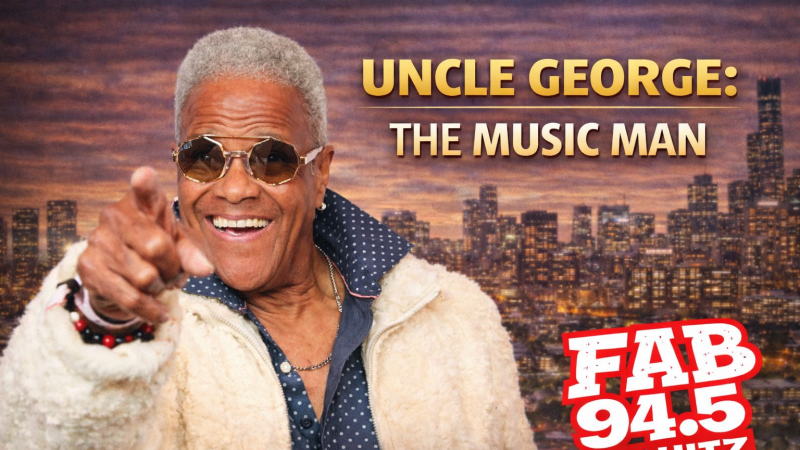
“Uncle George: The Music Man”
Published on Feb 25, 2026
How George Daniels Built Chicago’s Most Important Record Store—and Became a Living Archive of Black Music Culture
On the West Side of Chicago, before streaming algorithms and before “link in bio,” there was a storefront where the future of Black music quietly passed through the front door.
Behind the counter stood George Daniels.
Born December 18, 1946, Daniels’ life traces the arc of modern Black music itself. To understand him is to understand the migration of sound—from Southern blues to Northern soul, from vinyl to digital, from neighborhood record shops to global stages. And for more than five decades, Daniels has stood at the intersection of it all.
They call him “Uncle George.” Not because of age alone—but because of stewardship.
From the Bronx to the Blues
Though often claimed by Chicago, Daniels was born in the Bronx, New York, to parents who owned restaurants. His childhood moved between relatives and regions, including time in Texas, where Southern rhythms seeped into his bones. But it was Chicago—the city he relocated to before high school—that shaped his musical destiny.
In Chicago, Daniels found himself immersed in a living soundtrack. Gospel spilled from churches. Blues bled from basement lounges. Soul crackled through AM radio. He picked up the trumpet in high school and later attended Loop College (now part of Harold Washington College), but his real education happened in places far less academic.
One of his earliest jobs? Janitor at Chess Records.
Imagine sweeping the floors where Muddy Waters recorded. Imagine emptying trash cans while the ghosts of electric blues rewrote American music upstairs. Daniels wasn’t just cleaning a building—he was absorbing the blueprint.
From there he moved into record distribution at United Distributors on Michigan Avenue, in the heart of what was once known as “Record Row.” It was here that he learned the mechanics of the music business: how records moved, how hits were broken, how relationships mattered more than hype.
He was watching. Learning. Preparing.
1969: Six Albums and a Dream
In 1969—just days before his 21st birthday—George Daniels opened George’s Music Room.
Inventory? Six albums. One hundred 45s.
Capital? Almost none.
Vision? Immeasurable.
He worked sixteen-hour days. Slept little. Learned fast.
The store quickly became more than retail space. It was a proving ground. A think tank. A community forum. DJs tested records there. Artists gauged reactions there. Neighborhood entrepreneurs gathered there.
Long before “cultural curator” became a job title, Daniels embodied it.
As the decades rolled forward, George’s Music Room grew into one of the Midwest’s most influential independent record stores. It eventually expanded, including a second location at Midway Airport—bringing Chicago’s sound to travelers passing through.
But the real power wasn’t square footage. It was access.
When Legends Walk In
Over the years, George’s Music Room became a mandatory stop for artists moving through Chicago. The list reads like a soul and hip-hop hall of fame: Mary J. Blige, LL Cool J, Al Green, Alicia Keys, and The Temptations, among many others.
They didn’t just come to sell units.
They came to see George.
Because Daniels had something invaluable: credibility in the streets and clarity in the business. He could tell an artist if a record would move in Chicago. He understood regional taste before data dashboards existed. And perhaps most importantly, he told the truth.
In an industry that often sells illusion, Daniels sold honesty.
The Godfather of Retail Music
Within Chicago’s independent music economy, Daniels became known as the “Godfather of Retail Music.” Not because he chased headlines—but because he built infrastructure.
He founded the National United Independent Retailers, advocating for Black-owned record stores at a time when consolidation threatened their survival. He understood early that ownership mattered. That community retail spaces weren’t just commerce—they were culture control.
Record stores were once the algorithm. And George was one of its chief programmers.
When the digital era arrived and brick-and-mortar stores across America shuttered, Daniels adapted. He explored new ventures, including George’s Beverage Depot, and remained active in community initiatives—hosting giveaways, feeding families, showing up when the neighborhood needed him.
He wasn’t just selling music anymore. He was sustaining legacy.
Style, Swagger, and Substance
Daniels has always carried himself with unmistakable flair. Sharp suits. Measured speech. A presence that announces experience before introduction.
But beneath the style is strategy.
He survived format wars. Survived the CD crash. Survived the streaming disruption. Survived economic shifts that erased hundreds of independent stores nationwide.
And through it all, he remained a connector—between artists and fans, between old school and new school, between commerce and culture.
In Chicago—a city that has birthed house music, drill, gospel legends, and soul royalty—that’s no small distinction.
The Keeper of Memory
Today, Daniels is celebrated as a living legend in Chicago. Documentaries and tribute events have recognized his impact. Younger entrepreneurs cite him as blueprint. Older musicians call him brother.
But the truest measure of his influence isn’t in plaques or posts.
It’s in the fact that multiple generations learned how music moves because of him.
Before social media metrics.
Before streaming counts.
Before viral moments.
There was George Daniels behind the counter, listening carefully to what the city wanted next.
Why He Still Matters
In 2026, when most music discovery happens through phones instead of storefronts, it would be easy to romanticize George Daniels as relic of a bygone era.
That would be a mistake.
Because what Daniels represents isn’t nostalgia. It’s foundation.
He embodies a time when cultural gatekeeping meant community accountability. When Black-owned retail spaces were economic engines. When mentorship happened face to face, not in DMs.
And in an age obsessed with disruption, there is something radical about a man who built something that lasted.
George Daniels didn’t just sell records.
He archived a city’s sound.
And in doing so, he made sure Chicago’s music story could never be erased.