Rhymefest: The Underrated Architect of Hip-Hop’s Moral Compass
Published on Feb 24, 2026
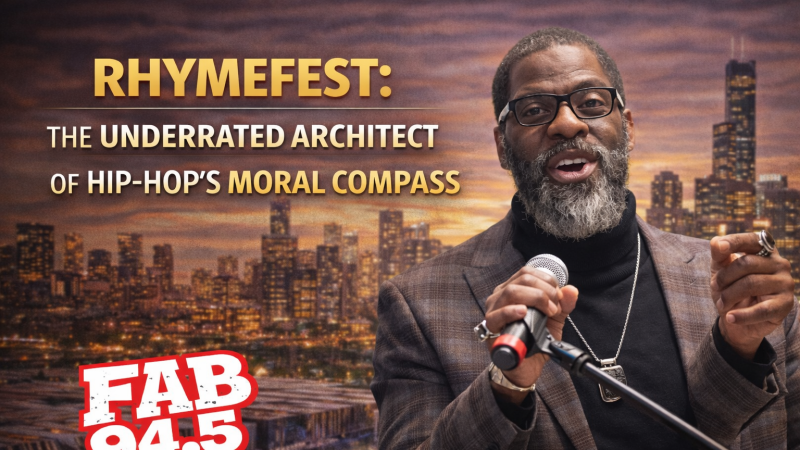
Chicago’s South Side isn’t just a backdrop for hip-hop mythology — it’s the fortress where some of the culture’s most uncompromising voices are forged. And among them stands Rhymefest, a lyricist whose name might not dominate every headline but whose fingerprints are on some of the most enduring songs of the 21st century, and whose life reads like a testament to hip-hop’s transformative potential.
From Brooklyn Projects to Chicago Streets
Born Che Armond Smith on July 6, 1977, in Chicago’s South Deering neighborhood, Rhymefest’s journey began much like many of his peers: battling in underground cyphers, sharpening his wit against anyone in earshot, and building a reputation as one of the most formidable freestylers in the Midwest. Before there were platinum plaques, there were hours spent at events like JumpOff and ScribbleJam — the gritty crucibles where he famously bested a young Eminem — and crafted a lyrical identity rooted in authenticity over bravado.
That early era — scribbling bars over borrowed beats, balancing fatherhood and low-wage jobs in Indiana, and navigating Chicago’s streets — instilled in him a worldview that would, years later, mark him as one of hip-hop’s most reflective thinkers.
The Kanye Connection: ‘Jesus Walks’ and the Art of the Message
If hip-hop had anthems for the soul, few resonated as deeply as “Jesus Walks.” Released in 2004, the song — co-written by Rhymefest and his friend Kanye West — dared to ask for religion, struggle, and redemption to coexist in a genre that often rewarded nihilism. The Grammy for Best Rap Song, which it won, wasn’t just a trophy — it was validation that rap could confront faith without compromise.
West’s meteoric rise often overshadows Rhymefest’s contribution, but industry insiders and aficionados alike acknowledge the older Chicagoan’s crucial role in shaping that record’s philosophical core — a pattern that would repeat throughout his career.
‘Blue Collar’: A Manifesto in Vinyl
In 2006, Rhymefest cemented his own voice with his debut album, Blue Collar. Eschewing the bling and escapism that dominated the era, the record — produced with heavyweights like Kanye West, Mark Ronson, and No I.D. — was a celebration of everyday survival and dignity. The standout single “Brand New,” featuring West, carried Brownstone soul and Chicago grit into international charts, staking a claim for socially conscious hip-hop on the global stage.
Yet the album’s impact wasn’t measured in gold records but in respect — from peers who saw in Rhymefest an artist who spoke to the overlooked, the working class, the unheard.
Beyond Music: World Building Through Culture and Activism
Where many artists fade into nostalgia, Rhymefest’s career evolved outward. He didn’t just make songs — he interrogated society.
In 2011, he ran for Chicago’s City Council in one of the city’s most violent districts, pushing the incumbent into a runoff and narrowing the gap despite limited political experience. He later co-founded Art of Culture (originally Donda’s House), a nonprofit that channels Chicago’s creative energy into youth mentorship and cultural empowerment — evidence of his belief that art isn’t an escape from life, but a vehicle for change.
His voice has traveled far beyond Chicago; he has spoken at the British House of Commons on hip-hop’s role in policy and education, and lectured at universities through prestigious fellowships, expanding hip-hop from entertainment into intellectual inquiry.
‘Glory’: A Song for the Ages
Half a decade after Blue Collar, Rhymefest’s pen continued to shape cultural milestones. He co-wrote “Glory” with Common and John Legend for the film Selma — a song that earned a Golden Globe and Academy Award and became an anthem for civil rights and collective resilience.
Rare is the artist whose work scores both Grammy stages and Oscar platforms. Rhymefest’s contributions span the spectrum — elegant in the booth, incisive in the boardroom, and purposeful in community halls.
The Modern Era: Legacy and Reflection
In 2024, Rhymefest released James & Nikki: A Conversation, a creative homage to Black literary giants James Baldwin and Nikki Giovanni, blending dialogue with contemporary hip-hop sensibilities. The project underscores his evolution from lyricist to cultural translator — bridging generational wisdom with modern artistic expression.
It’s a fitting next chapter for a man whose life has been defined by dialogue — between tradition and innovation, street wisdom and academic thought, artistry and advocacy.
Why Rhymefest Matters
In an era when hip-hop can feel commodified, Rhymefest remains a reminder that the genre’s roots were always deeper than rhythms and rhymes — that it was a pulpit for truth, a platform for community, and a language for the marginalized.
His story — from rap battles to Grammys, from nonprofit boardrooms to policy forums — isn’t just about success. It’s about intentionality: using one’s voice not just to be heard, but to help others speak.
And maybe that’s the real masterpiece.