Traxster: The Unseen Architect of Chicago Hip-Hop’s DNA
Published on Feb 23, 2026
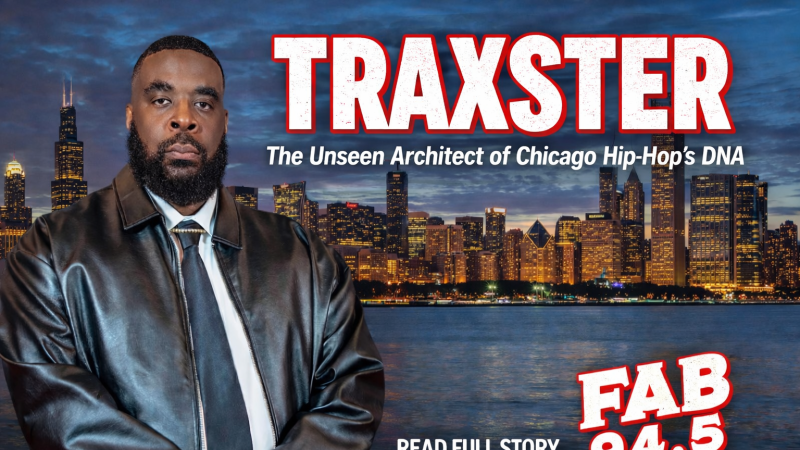
In the mid-’90s, when hip-hop’s power centers were firmly planted in New York and Los Angeles, Chicago was still considered flyover territory — rich in talent, heavy in hustle, but missing a defining sonic architect. Then came a producer with an ear for darkness, discipline, and double-time precision: The Legendary Traxster.
Before the plaques, before the Grammy nod, before the industry caught up to what the Midwest already knew — Traxster was building a sound in real time. And that sound would become the genetic code of Chicago hip-hop.
South Side Foundations
Born Samuel Lindley in 1973 and raised in Chicago’s Pocket Town neighborhood, Traxster didn’t enter music through the industry machine — he entered through necessity and instinct. As a teenager, he battled as part of the group D 2 Tha S (Dedicated 2 Tha Streets), sharpening lyrical skills while quietly studying production structure.
What separated him wasn’t just talent — it was architecture. He understood tempo as tension. He understood space as power. And he understood that Chicago rappers — particularly the city’s rapid-fire spitters — needed something different beneath them.
At a time when West Coast G-funk leaned melodic and East Coast boom-bap leaned sample-heavy, Traxster began crafting slow-rolling, bass-thick instrumentals that left room for speed rap to breathe without sounding chaotic. It was controlled aggression — cinematic but street-rooted.
“Po Pimp” — The Earthquake Moment
In 1996, the Midwest shifted.
Produced by Traxster, “Po Pimp” by Do or Die featuring Twista wasn’t just a hit — it was a statement. The record climbed the Billboard charts and forced the industry to acknowledge Chicago’s presence. The production was eerie, hypnotic, minimal yet muscular. It didn’t chase coastal trends. It bent them.
The success of the single propelled Do or Die’s debut album Picture This to platinum status. But inside Chicago, the conversation wasn’t just about the rappers. It was about the producer.
Traxster had engineered a regional sound that felt both polished and underground — commercially viable without sacrificing street DNA.
Adrenaline Rush: A Producer’s Masterclass
Then came 1997’s Adrenaline Rush — a defining album by Twista, produced entirely by Traxster.
Entirely.
In an era when albums were often patchworks of multiple producers, Traxster’s full-project control gave the album cohesion — a sonic world with its own gravity. The drums knocked with restraint. The basslines crawled instead of sprinted. The beats felt like night drives down Lake Shore Drive with something to prove.
The album went platinum. But more importantly, it codified the Chicago double-time aesthetic. Speed rap no longer felt like novelty. It felt strategic. Intentional. Deadly.
Producers across the Midwest began emulating the formula: slowed tempos paired with rapid lyricism. The contrast created intensity without clutter — a blueprint that still echoes in modern production.
From Regional Kingmaker to Industry Force
By the early 2000s, Traxster’s résumé expanded beyond Chicago circles. His work began reaching national heavyweights, and his versatility became undeniable.
In 2005, he co-wrote and co-produced “One and Only” for Mariah Carey on her comeback album The Emancipation of Mimi. The project earned multiple Grammy wins and nominations, marking Traxster’s entry into pop and R&B’s highest tier.
He later co-produced “My Chick Bad” for Ludacris featuring Nicki Minaj — a platinum record that dominated radio and club circuits.
It proved something important: Traxster wasn’t boxed into one regional identity. His production philosophy — tension, clarity, controlled minimalism — translated across genres.
The Business Mind: Nothing But Dope
Long before producers openly branded themselves as CEOs, Traxster understood ownership. His imprint, Nothing But Dope, wasn’t just a label name — it was a thesis statement. Quality over hype. Substance over shortcuts.
In 2017, he inked a deal reviving Priority Records, aligning his imprint with a legacy West Coast powerhouse. It was a full-circle moment: a Midwest architect partnering with a label that once defined California’s golden era.
He also formed House Lindley alongside singer-songwriter Tia London — blending business, creativity, and family into a sustainable ecosystem.
Influence on Drill and the Modern Era
Though drill music would later explode globally through artists like Chief Keef, its dark tonal palette — the ominous atmospheres, the heavy low-end — can trace philosophical lineage back to Traxster’s blueprint.
He didn’t invent drill. But he helped normalize darkness in Chicago production. He helped establish mood as identity.
That matters.
Because before a city can export a sound, someone has to define it internally.
Legacy: The Producer’s Producer
Traxster isn’t the loudest name in the room. He’s not chasing viral moments. His legacy lives in structure — in the way Chicago records feel when they knock.
He belongs in conversations alongside regional architects like DJ Screw, J Dilla, and Dr. Dre — not because he mimicked them, but because he did for Chicago what they did for their cities: he gave it a sonic fingerprint.
Three decades in, his résumé reads like a map of hip-hop’s evolution — underground independence, platinum mainstream success, cross-genre credibility, and business ownership.
But ask anyone who really studies production, and they’ll tell you the truth:
Traxster didn’t just make beats.
He built infrastructure.
And Chicago still runs on it.