Crucial Conflict: Chicago’s Rodeo Rebels and the West Side Sound That Burned Up the ‘90s
Published on Feb 24, 2026
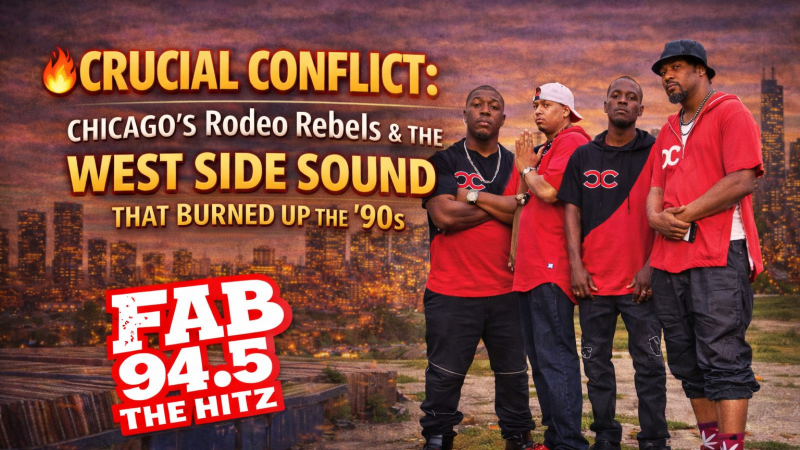
When “Hay” erupted onto the national charts in 1996, it didn’t just introduce a song — it introduced a world. A world where West Side Chicago grit met an unfettered outlaw spirit, a Midwest variant of hip-hop unbound by bi-coastal conventions, grounded in blunts, thunderstorms of rapid-fire rhyme, and a swagger that felt as raw as the city it came from.
At its core stand four men — Wondosas “Kilo” Martin, Ralph “Wildstyle” Leverston, Corey “Coldhard” Johnson, and Marrico “Never” King — born and bred on Chicago’s West Side, bonded first by the streets and then by the mic. Their sound was unapologetically Chicago: a collage of high-velocity flows, gritty narrative, and an aesthetic they themselves called “Rodeo style,” a sonic blend that stitched together Cypress Hill’s weed philosophy with motifs from the Old West.
From the Barn to the Billboard Charts
Crucial Conflict’s journey began humbly. In 1993 they cut their teeth with a seven-track EP, Crucial Times, released independently — an underground calling card that hinted at something distinct brewing in the Midwest. But it was their 1996 full-length debut, The Final Tic, that changed everything. Released through Universal, the album was driven by one unignorable moment: “Hay.”
“Hay” was more than a hit single; it was a cultural flashpoint. With a hypnotic groove built around a sample of Funkadelic and an irresistible chorus celebrating weed culture with rural swagger, the track climbed to number 18 on the Billboard Hot 100. It went gold, and so did The Final Tic, sealing Chicago’s claim on the national hip-hop map.
What seemed like a novelty — rappers from Chicago celebrating herb and hard times — was, in reality, the emergence of a new regional voice. Midwest rap had its own cadence, its own iconography, and Crucial Conflict became one of its earliest ambassadors.
Cultural Tides and the “Rodeo” Sound
The group’s impact wasn’t just commercial; it was stylistic and definitional. Amid an era dominated by East Coast lyricism and West Coast G-funk, Crucial Conflict, alongside peers like Do or Die and Twista, charted a distinct Midwest course. Their flows were rapid, their beats were tilting between Chicago crank and country grit, and their mythic imagery — hay bales, barns, bandanas — created a world both playful and menacing.
Critics took notice. Within the city and beyond, the group was discussed not just as a novelty act but as a genuine movement. Rolling Out’s list of influential Chicago rappers positioned Crucial Conflict alongside other game-changers, and hip-hop heads debated their influence on the Midwest’s chopper style, even as some inaccurately compared them to Bone Thugs‑n‑Harmony because of the multi-member interplay of verses.
Two Albums, One Legacy
Following the breakthrough of The Final Tic, the group returned in 1998 with Good Side, Bad Side. The sophomore effort was heavier, not just in beat but in narrative. It featured collaborations with R. Kelly and Memphis’s Tear Da Club Up Thugs, and showcased a Chicago crew now comfortable with its own voice. Numbers on the charts were respectable — the album landed at number 38 on Billboard 200 — but the commercial mystique of “Hay” proved difficult to replicate.
The record also reflected the group’s place in the broader hip-hop ecosystem. Songs like “Back Against the Wall” channeled simmering rivalries, notably with Bone Thugs-n-Harmony, a moment that underscored regional pride and competitive energy that defined much of late ’90s rap.
Yet despite a dedicated fan base and undeniable talent, internal challenges and label constraints would sideline the group. A split in 1999 sent members in separate directions — a familiar story in an era when major label machinations frequently eclipsed artistry.
Resurgence and Enduring Influence
After nearly a decade away from the spotlight, Crucial Conflict returned in 2008 with Planet Crucon, a project that reasserted their identity on independent terms. While it didn’t reach the commercial heights of their youth, it affirmed their artistic longevity and cemented their legacy in Midwest hip-hop lore.
Since then, the group has never fully disappeared. They’ve performed at festivals like SXSW, continued to collaborate with peers, and even released new music as recently as 2024, reminding audiences that their story — like their beats — refuses to stay buried.
Why Crucial Conflict Still Matters
Today, hip-hop scholarship and retrospectives look back at the group not as a footnote but as a formative piece of Chicago’s unique musical tapestry. They were part of a generation that expanded what Midwest rap could sound like, blending hard street narratives with an aesthetic playfulness rarely matched by their contemporaries. Their work heralded subsequent Midwest innovations — from drill to hyper-rapid flows — and stands as a testament to the city’s restless creativity.
In the end, Crucial Conflict’s legacy isn’t defined solely by the fame of a single song. It’s in the way they introduced the world to Chicago’s West Side — barn dances and hood haze, streets and swagger — and made it feel, for a moment, untouchable.