Lupe Fiasco: The Relentless Architect of Thoughtful Hip-Hop
Published on Feb 12, 2026
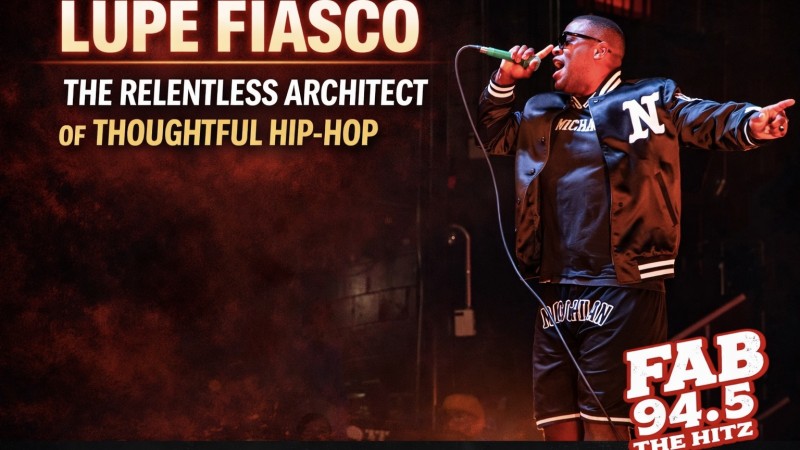
When hip-hop is discussed in the same breath as poetry, philosophy, and cultural critique, one name inevitably rises: Lupe Fiasco. Nearly two decades after he first burst onto the national stage, the Chicago-born MC — born Wasalu Muhammad Jaco on February 16, 1982 — occupies a rare space in music: an artist whose creative genius is matched by his intellectual curiosity and cultural consciousness.
From Chicago’s Neighborhoods to a Voice of Conscience
Growing up in Chicago, Lupe’s early relationship with hip-hop was ambivalent; he was drawn to its energy but repelled by its brash misogyny and materialism. That tension shaped much of his ethos — a refusal to follow hip-hop’s commercial scripts in favor of something more introspective. By age 19 he was recording in his father’s basement, cutting his teeth in groups like Da Pak and releasing mixtapes that showcased a sharp mind as much as a sharp flow.
His breakthrough came not from a blinding solo debut, but through a feature: Lupe’s appearance on Kanye West’s “Touch the Sky” in 2006 introduced a wider audience to his crystalline wordplay and reflective perspective.
A Debut That Changed the Conversation
Later that year, his debut album, Lupe Fiasco’s Food & Liquor, landed like a manifesto. Executively produced in part by Jay-Z, the record juxtaposed skateboard culture (“Kick, Push”) with cut-through lyrics about absent parents, racism, and identity. The title itself — referencing corner stores in Chicago’s neighborhoods — stood as an allegory for life’s moral battles: the tug of war between sustenance and temptation.
Critics and fans alike recognized something rare: hip-hop with intellectual depth that didn’t retreat from mainstream sound. The album earned four Grammy nominations, and “Daydreamin’” won Best Urban/Alternative Performance at the 50th Grammy Awards.
The Cool and the Expansion of Narrative
His sophomore project, Lupe Fiasco’s The Cool, arrived in 2007 with a more ambitious narrative arc. Drawing on personal grief — including the loss of his father — the album fleshed out characters like “The Streets” and “The Game,” painting gritty American reality with cinematic lyricism.
Tracks like “Superstar” elevated Lupe from underground darling to chart fixture, but he remained tethered to a deeper mission: using hip-hop as a mirror to society’s contradictions.
Lasers, Labels, and Creative Struggles
The ensuing years were marked by tension between artistic vision and label politics. Lasers (2011) debuted atop the Billboard 200 and gave him his biggest commercial hit, “The Show Goes On,” but its delayed release and compromises diluted its critical impact.
Lupe responded by asserting control over his own career, founding 1st & 15th Entertainment and releasing the ambitious Food & Liquor II (2012) and the critically lauded Tetsuo & Youth (2015), which restored his reputation as one of hip-hop’s most potent storytellers.
Independence and Artistic Flourishing
The late 2010s into the 2020s saw Lupe embrace his independence fully. Records like Drogas Light (2017), Drogas Wave (2018), and Drill Music in Zion (2022) showed an artist unafraid to evolve, experiment, and demand intellectual engagement from his listeners.
In 2024, he released Samurai, a conceptual project that reimagined the late Amy Winehouse as a battle rapper — a testament to his ability to fuse history, metaphor, and genre into something wholly innovative.
Beyond Music: The Scholar-Artist
Lupe’s journey has always defied categorization — and in recent years, he has expanded into academia. Serving as a visiting professor and scholar at prestigious institutions including MIT and Yale, he teaches courses on rap theory, culture, and linguistic artistry.
In 2025 he was named a Distinguished Visiting Professor at Johns Hopkins University’s Peabody Institute, where he’ll teach rap as part of the first Bachelor of Music in Hip-Hop program in the United States — a historic milestone for both the genre and higher education.
His work with AI and creative technology, including collaborations like Google’s TextFX, has earned him Webby Awards and positioned him at the intersection of art and innovation — not as an afterthought, but as a leading voice in how culture and technology converse.
Legacy of Thoughtful Rebellion
Lupe Fiasco’s legacy isn’t measured in sales figures alone — though he has sold millions of units; it’s measured in the conversations he’s forced listeners to have with themselves. He refuses the easy platitudes of mainstream rap, choosing instead narratives that challenge, provoke, and console.
From Chicago’s basement studios to global stages, from chart success to classrooms revered for scholarly rigor, Lupe Fiasco embodies hip-hop’s potential not just as entertainment, but as a vehicle for thought, reflection, and transformation.
In an era when much of culture moves at 280 characters or viral clips, he stands as a reminder that the deepest art often requires time, complexity, and a fearless mind willing to ask the questions no one else will.