No I.D.: The Sound Architect Who Quietly Shaped Hip-Hop’s Soul
Published on Feb 12, 2026
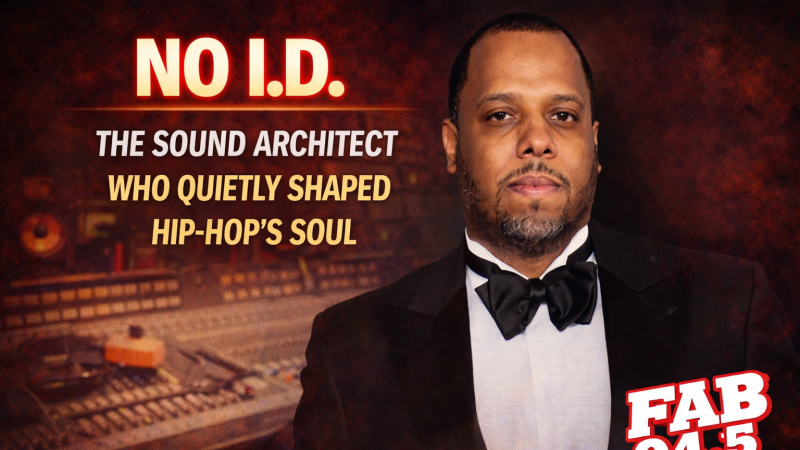
Long before hip-hop became a global industry fueled by streaming algorithms and meme-ready hooks, there was Chicago — a Midwestern crucible of house music, street poetry, and scrappy cultural defiance. From that landscape emerged Ernest Dion Wilson, known to the world as No I.D.: a producer whose fingerprints are imprinted on some of the most seminal movements, records, and careers in modern music.
Chicago Beginnings: House, Hip-Hop, and the First Spark
Born on June 23, 1971, in Chicago, Illinois, Wilson grew up in a city where house music reigned supreme, and hip-hop culture was still being deciphered by local audiences. He started as a DJ, immersed in house and early rap influences — sampling cassette tapes, spinning at parties, and intuitively learning the language of rhythm.
But it wasn’t long before hip-hop’s soulful echoes captured his imagination. Inspired by giants like Rakim and driven by his own creative curiosity, Wilson transitioned from dancing to DJing to producing beats — the spark that would define his life’s work.
Common and the Birth of a Sound
Wilson’s first major partnership was with fellow Chicago native Common (then Common Sense). Together, they forged a sound that fused jazz warmth with razor-sharp lyricism — a stark contrast to the dominant West Coast funk and East Coast boom-bap of the early ’90s. Wilson produced much of Common’s first three albums, including the seminal Resurrection, which featured the deeply introspective anthem “I Used to Love H.E.R.” — a track many regard as a defining moment in conscious hip-hop.
This early work wasn’t just background music; it was cultural argumentation — storytelling through samples, space, and groove. Chicago suddenly had a voice on the hip-hop map, and No I.D. was its beat-making champion.
Mentor of a Generation: Kanye, J. Cole, Logic
Perhaps No I.D.’s most enduring legacy isn’t a chart position or award, but the artists he cultivated. In the late ’90s, a young Kanye West — then a Cicero-raised producer selling beats out of his basement — began attending sessions with No I.D. Wilson recognized something rare in the teenager: a musical sensibility that extended far beyond rap tropes, one that could feel both intimate and universal. He introduced West to industry contacts and taught him the nuances of production that would later define an era. Kanye would repay the favor with artistic homages — thanking No I.D. in tracks like “Big Brother” and “Last Call.”
That mentorship ethos didn’t stop with Ye. Artists such as J. Cole and Logic have cited No I.D. as a guiding force early in their careers, a testament to his ear not just for sound but for untapped potential.
From Producer to Hitmaker to Executive
While his early work was rooted in soulful, jazz-inflected hip-hop, No I.D. proved just as adept in the mainstream. In the 2000s and 2010s, he produced landmark hits for artists across the spectrum: Jay-Z’s “Run This Town” and “Holy Grail,” Kanye West’s “Heartless,” Drake’s “Find Your Love,” and countless others that helped define commercial rap and R&B.
His versatility — from classic sample chops to polished pop sensibilities — made him one of the most sought-after producers of the era. In 2017, he produced the majority of Jay-Z’s critically acclaimed 4:44, a project lauded for its mature lyricism and minimalist yet profound musical palette.
But No I.D.’s influence extended beyond the studio. He became president of Kanye’s G.O.O.D. Music, later served as Executive Vice President of A&R at Def Jam Recordings, and launched his own imprint, ARTium Records, helping cultivate artists such as Vince Staples, Jhené Aiko, Snoh Aalegra, and more.
Legacy and the Quiet Giant
Despite selling his entire catalog — a massive collection of 273 songs — to Hipgnosis Songs Fund in 2020, No I.D.’s legacy isn’t reduced to a transaction. His work has been streamed billions of times and continues to resonate across generations of listeners and musicians alike.
In an industry that often equates volume with value, No I.D. represents a quieter truth: that real influence is measured not just in hits, but in craft, presence, mentorship, and evolution. From Chicago’s underground to the world’s biggest stages, Ernest Dion Wilson didn’t merely produce records — he shaped the contours of a culture.
Hip-hop didn’t just evolve with No I.D. — it listened to him.