Psychodrama: Chicago’s Lost Legends and the Unfinished Story of a Street-Soul Hip-Hop Force
Published on Feb 27, 2026
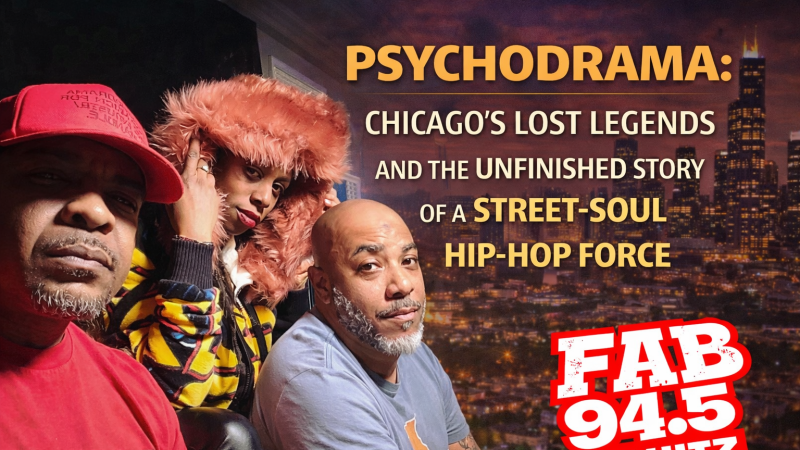
By the time hip-hop officially crowned Chicago as a powerhouse in the early 1990s, feats from Twista’s speed-rapping to Crucial Conflict’s freewheeling swagger had already turned the city’s West Side into a melting pot of styles. But amid those emergent narratives — largely documented and celebrated — another story quietly took shape, one that never fully made its way into the mainstream canon. This is the story of Psycho Drama, a Chicago rap collective whose rhythmic grit and haunting honesty embodied the raw soul of the city’s streets but never got its full due.
Where It All Started: The Late ’90s Chi-Town Underground
In 1994, a trio out of Chicago’s urban core — composed of Yungbuck (often stylized as Buk), Psyde FX, and female MC New Sense — began pressuring the local hip-hop ecosystem with tapes and independent releases that fused lyrical dexterity with unvarnished narratives about life on the ground in Chicago’s neighborhoods. Operating under the name Psychodrama, they were affiliated with indie outfits like The Padded Room Recording Company and U-Chi Records, emblematic of the city’s grassroots hip-hop infrastructure.
Their early releases — cassette tapes circulated at block parties and local record shops — were shockingly honest and electric. Songs like “Magic” and “Uh Huh (You Right)” rippled through Chicago radio waves and underground circles, offering a fresh voice that blended swagger with verité storytelling.
There was something about the combination of Buk’s baritone, Psyde’s sharp cadence, and New Sense’s incisive verses that felt like Chicago talking to itself — not a sanitized version for mainstream ears, but an authentic expression of city life’s sharper edges.
The Industry Beckons — And Walls Close In
By the mid-’90s, Psychodrama’s buzz began to attract attention from major players. Producer The Legendary Traxster — a pivotal architect of Chicago rap known for his work with Twista and Do or Die — produced key early cuts for the group, adding a sonic sheen that revealed their commercial potential.
Soon enough, the Houston powerhouse Suave House Records came calling. At that point, Suave House was one of the most influential Southern independent labels — home to Eightball & MJG and a roster hungry to expand its reach. Psychodrama inked a deal and began crafting what was to be their major-label debut, Time Versus Life.
On paper, this should have been Psychodrama’s breakout moment. Suave House had national distribution, a roster of artists who regularly broke into Billboard charts, and a network eager to push regional talents into wider recognition. For Psychodrama, it was validation after years of independent hustling.
But everything did not go according to plan.
Time Versus Life: The Album That Never Was
Today, the Time Versus Life sessions occupy something close to mythic status among die-hard fans. According to multiple archival accounts, the album was completed — nearly ready for release — and even advertised widely in magazines like The Source before being shelved amid distribution issues and label shakeups.
This unfulfilled pivot from independent street sensations to nationally marketed artists became a defining moment. Their association with Suave House was celebrated, but the ultimate disappearance of their major-label debut solidified a narrative of “almost but not quite” — a recurrent theme in stories of promising hip-hop acts who simply couldn’t navigate an industry rife with missteps and missed opportunities.
Beyond the Numbers: Legacy in the Streets
While charts and sales never reflected Psychodrama’s talent, their presence in Chicago’s hip-hop memory did. Local DJs, mixtape collectors, and old heads still reminisce about cassettes with Psychodrama scrawled on them, about shouting the hook of “Do What You Wanna Do” in cars rolling down Pulaski or Chicago Avenue.
Their music became part of an oral tradition — passed down, swapped on tapes, and playing a role in shaping the gritty realism that would later find broader recognition through artists like Common, Kanye, and Chance, who each, in their ways, helped bring Chicago back to the national hip-hop conversation.
Songs like “Beenadone Some Shit” and “Drama In My Life” weren’t just tracks — they were testimonials, articulating a perspective that many young Chicagoans lived but few heard on a big stage.
The Mystery of the Missing Album & Current Resurgence
In the years that followed, Psychodrama largely faded from the wider hip-hop narrative. Some members pursued solo efforts or disappeared into the city’s vast musical undercurrent. But the mystique persists. In recent years, crowds on social platforms have resurfaced clips, shared memories, and asked again and again: Where is that album? Will it ever drop?
Part of Psychodrama’s mystique is this very absence — the idea of a brilliant piece of work trapped forever in limbo. And yet, even without a platinum plaque or a marquee tour, their influence quietly persists. They are, in many ways, a link between the underground hustle of early Chicago rap and the city’s eventual global spotlight.
What Really Matters
In the end, Psychodrama’s story isn’t one about mainstream success. It’s a story about resilience, about the art that thrives where there’s little spotlight, about voices that refuse to be silenced even when the world looks the other way.
Their beat — rough, raw, relentless — was never just about rap. It was about a city’s heartbeat, its struggles, its ambitions, and its soul.
And maybe — just maybe — that unfinished album isn’t a loss at all. Maybe it’s a promise that some stories are too powerful to be confined to charts or mainstream acclaim. Some stories live forever on the streets that first breathed life into them.