Will Gates: From Englewood to the Director’s Chair
Published on Feb 13, 2026
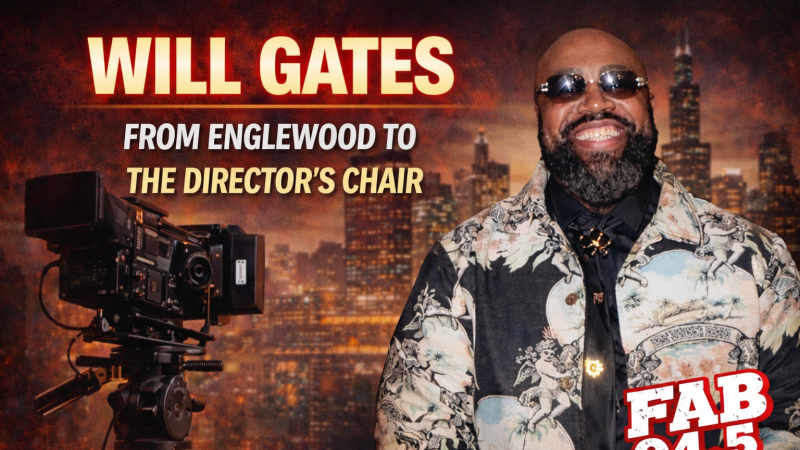
How Will Gates Built a Cinematic Empire Without Leaving His Roots
By the time you meet Will Gates, you realize something immediately: he doesn’t speak like a man chasing fame. He speaks like a man chasing legacy.
Raised in Chicago’s Englewood neighborhood, Gates came of age in a part of the city often reduced to headlines. Violence. Poverty. Statistics. But for Gates, Englewood wasn’t a statistic — it was texture. It was atmosphere. It was story. And before he ever touched a professional camera, he was already studying light, tension, and human behavior the way some kids study box scores.
The spark came in the late ’90s when he watched Belly — Hype Williams’ neon-soaked cult classic. For many, it was just a stylish crime film. For Gates, it was revelation. Cinema could look like the block. It could feel like the block. It could be the block.
That moment didn’t just inspire him. It redirected him.
Film School, but Make It Real
Gates enrolled at Columbia College Chicago, majoring in film with a concentration in directing. Unlike many aspiring filmmakers, he wasn’t chasing Hollywood abstraction — he was building craft with intention. Under the mentorship of respected cinematographer Ron Pitts, Gates sharpened both his technical instincts and narrative discipline.
Film school gave him language. Englewood gave him perspective.
And perspective is the difference between a director who imitates and one who originates.
The DVD Hustle That Predicted the Internet Era
Before Instagram reels, before YouTube algorithms, before “content creator” became a job title, Gates launched something radically forward-thinking: a DVD magazine called Chicago Version through his company Open World Films.
It was 2003.
He wasn’t waiting for a network. He wasn’t waiting for permission. He was documenting Chicago’s music ecosystem — the underground energy, the studio sessions, the rising stars. And he was selling the DVDs himself.
More than 10,000 independent copies moved through the streets. That’s not viral. That’s infrastructure.
The project connected him with artists who would later become global names — creatives like Kanye West, Common, and John Legend — at a time when Chicago’s creative renaissance was still brewing.
Gates wasn’t just filming culture. He was archiving it.
800 Music Videos Later…
Most directors might build a career off 20 music videos. Gates built one off more than 800!
Let that sit.
Over the years, he’s directed visuals for artists spanning generations and regions — from Chance the Rapper to Rick Ross, Gucci Mane, and Meek Mill.
His style? Clean but gritty. Cinematic without losing urgency. He understands pacing the way DJs understand tempo — when to let a shot breathe and when to cut on impact.
Networks like BET and MTV broadcast his work nationally, but Gates never felt like he was chasing television validation. The streets were always the first audience.
That discipline — shoot fast, shoot smart, tell the story — built a muscle most directors never develop.
Crossing Over: Television, Documentary, and Global Reach
While many music-video directors stall when trends change, Gates expanded.
He produced episodes for Drugs, Inc. on National Geographic, diving into raw, unfiltered subject matter that mirrored the environments he knew intimately.
His work reached international audiences, earning recognition including a nomination for the Deutscher Fernsehpreis — Germany’s equivalent of the Emmys. That’s not just crossover appeal. That’s range.
He also contributed to Netflix’s Dope, a docuseries exploring the global drug trade with cinematic intensity. Gates didn’t glamorize the chaos. He contextualized it.
And context is power.
The Feature Film Era
The transition from music videos to feature films is where many directors falter. The pacing changes. The patience required multiplies. Narrative arcs stretch.
Gates didn’t falter.
With projects like Secrets of A Side Chick, Win for Losing, and The Candy Store, he stepped firmly into long-form storytelling — relationship drama, layered character work, and stories rooted in everyday complexity.
These aren’t spectacle films. They’re human films.
Gates leans into emotional realism — the quiet betrayals, the ambition, the survival instincts. The same instincts he witnessed growing up.
The Blueprint: Ownership Over Optics
Here’s what separates Will Gates from the average industry climber: he built his ecosystem before the industry acknowledged it.
He didn’t wait for a co-sign from Los Angeles. He built Open World Films.
He didn’t wait for streaming to validate him. He created volume.
He didn’t pivot when trends changed — he expanded.
In an era obsessed with virality, Gates chose sustainability.
And sustainability wins.
The Man Behind the Monitor
Talk to him and you won’t hear ego. You’ll hear precision. You’ll hear planning. You’ll hear someone who understands that longevity in film isn’t about one hit — it’s about consistent execution.
The Englewood kid who once saw Belly and imagined possibility now commands sets, directs actors, and builds narratives that stretch far beyond the block he grew up on.
But he never left it spiritually.
Because for Will Gates, the mission was never escape.
It was elevation.
And he’s still climbing.